What Is Physical Observability?
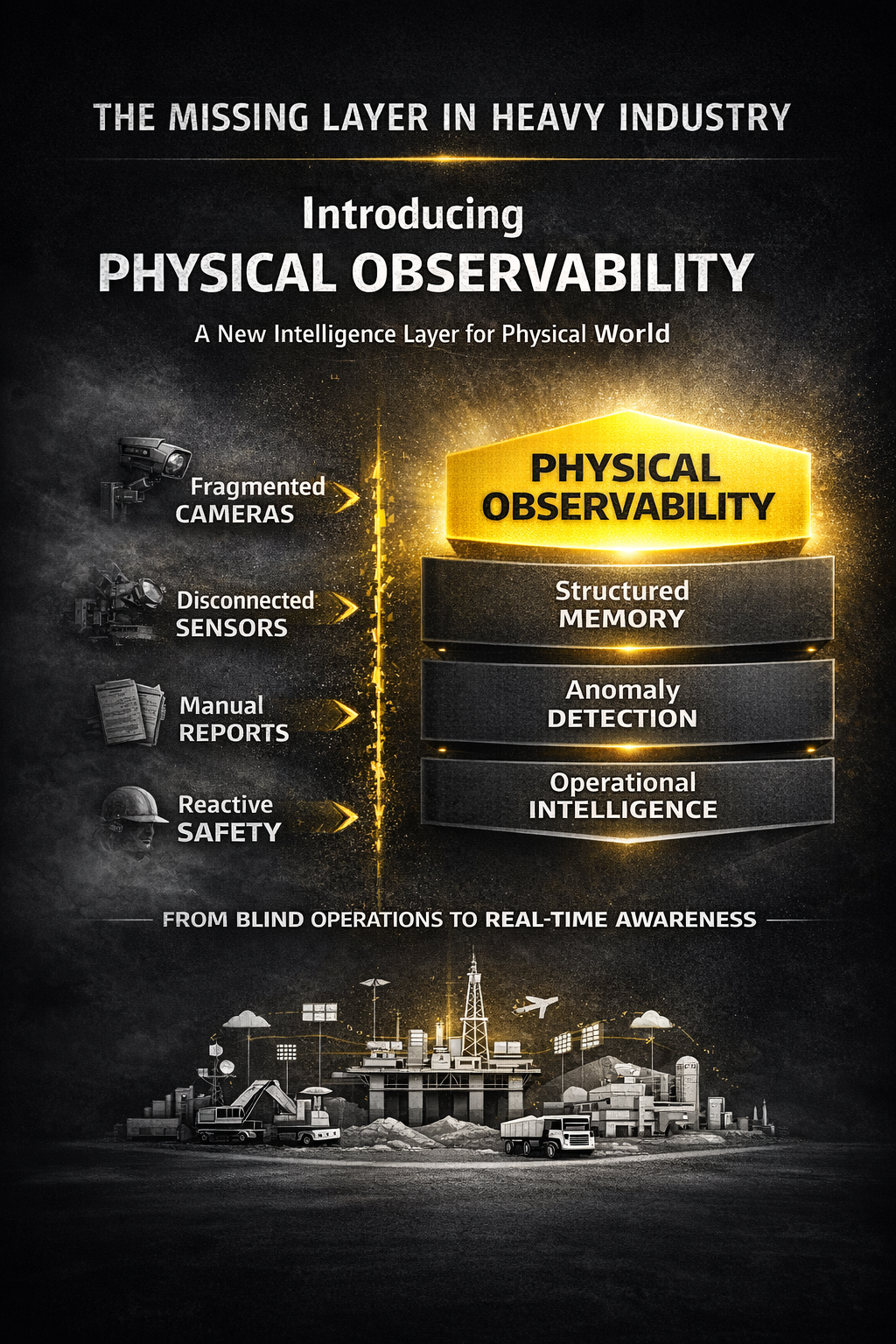
A mining company operates across three remote regions. An oil and gas group manages assets spread over thousands of square kilometers. A logistics operator runs distribution hubs that never stop moving. A defense organization oversees infrastructure fragmented by geography and security layers. A government agency is responsible for critical public assets across multiple provinces.
They all have cameras. They all have sensors. They all have reports. And yet, when operations begin to drift, they often find out too late. Not because there was no data. Because there was no unified understanding.
Definition
Physical observability is the ability to interpret, contextualize, and reason about physical-world signals across space and time, transforming cameras, sensors, telemetry, and external data into structured operational intelligence.
It turns fragmented physical signals into a unified, queryable operational layer. It is not surveillance. It is not traditional video analytics. It is not a dashboard. It is the connective intelligence layer for physical operations.
The Real Problem: Fragmented Vision
Today, physical data lives in silos. Security monitors cameras. Operations tracks production metrics. Maintenance reviews equipment telemetry. Safety tracks incidents. Compliance reviews reports. Each stakeholder sees a slice of reality. No one sees the whole.
Even when advanced systems exist, they are verticalized. PPE detection. Intrusion alerts. Asset tracking. Equipment monitoring. These systems answer narrow questions. They do not connect the dots. And connecting the dots is the real problem.
A safety signal may relate to environmental conditions. An equipment anomaly may correlate with human behavior. A slowdown in throughput may align with congestion patterns and access drift. When data remains isolated, patterns remain invisible.
Physical observability explicitly focuses on connecting the dots across diverse physical datasets, stakeholders, and systems to create a 360-degree operational view. Safety is one slice. Security is one slice. Operations is one slice. Physical observability connects them into one coherent operational understanding.
Why Now?
First, physical data volume has exploded. Cameras are everywhere. Sensors are inexpensive. Enterprises now generate massive physical signal. But signal without integration creates noise.
Second, AI can now reason across modalities. Modern vision language models and multimodal AI systems can interpret video, telemetry, environmental data, and geospatial context together. Structured memory and graph reasoning allow systems to detect not just events, but evolving patterns.
Third, operations are geographically distributed by default. Leadership cannot physically observe what is happening. Distributed scale without integrated visibility creates fragility. The convergence of distributed operations, multimodal AI, and massive physical signal makes physical observability not optional, but foundational.
The Three Layers of Physical Observability
Perception: Signals are collected from cameras, environmental sensors, equipment telemetry, access systems, GPS, drones, and satellite imagery. Most organizations already have fragments of this layer. What they lack is integration.
Context and Memory: This is the defining layer. Physical observability builds structured memory of people, assets, locations, movements, and environmental conditions. With memory, systems can distinguish between normal variation and systemic drift.
Reasoning: Reasoning connects signals across space and time. Instead of reacting to isolated alerts, organizations can identify behavioral drift across shifts or unusual access patterns. Monitoring tells you something happened. Observability helps you understand why it matters.
ROI of Physical Observability
Physical observability creates measurable value by reducing blind spots: Risk reduction through early detection of unsafe behavioral drift; Operational efficiency gains through identification of bottlenecks; Improved asset utilization; and lower investigation time through correlated signals. The return is not in generating more alerts. It is in detecting drift before it compounds into incidents or losses.
A Concrete Example
Consider an industrial plant where workers must maintain three points of contact while using stairs. Traditionally, enforcement relies on training and intermittent supervision. With physical observability, vision models detect posture and contact points in real time. Over time, leadership can analyze whether the behavior is increasing, isolated to one shift, linked to fatigue, or associated with specific operational pressure. This transforms behavior into structured, analyzable intelligence.
Industry Implications
In mining, it enables structured memory of near misses. In oil and gas, it provides a unified lens across pipelines and platforms. In logistics, it identifies congestion trends and process drift. In defense, it enables correlation across security layers and persistent memory of physical interactions. When physical events become queryable, they become governable.
The Strategic Shift
Digital infrastructure required observability to become reliable. Physical infrastructure is now reaching that same inflection point. Scale without observability creates fragility. Scale with observability creates resilience.
Physical observability is not a feature. It is a foundational intelligence layer for distributed operations in the modern world. The physical world is becoming queryable. And once it becomes queryable, it becomes governable.
Sama-Carlos Samamé
CEO & Co-founder
Jalaj Jain
CTO & Tech-Founder